Official figures
Facts, with the official wording left intact
The fact sheet is for tabulated figures. NASA Science is for the public wording, often rounded. This list does not pick a winner when they differ.
Tabulated figures are from the NASA / NSSDCA Earth Fact Sheet. [source] Public wording is from NASA Science’s Earth facts page. [source] Where they differ, both are kept.
- Place in the solar system
- NASA Science: third planet from the Sun; fifth largest; the only place we know of inhabited by living things; the only planet with liquid water on the surface; the only planet whose English name does not come from Greek or Roman mythology.
- Mass, volume, radius
- Fact sheet: mass 5.9722 × 1024 kg; volume 108.321 × 10¹⁰ km3; equatorial radius 6,378.137 km; polar radius 6,356.752 km; volumetric mean radius 6,371.000 km; core radius 3,485 km; flattening 0.003353. NASA Science: equatorial diameter 7,926 miles (12,756 kilometres); biggest of the terrestrial planets.
- Density, gravity, escape velocity
- Fact sheet: mean density 5,513 kg/m3; mean surface gravity 9.820 m/s2 (standard acceleration, CODATA 2018, 9.80665 m/s2 exact, noted on the same sheet); escape velocity 11.186 km/s.
- Albedo and solar irradiance
- Fact sheet: Bond albedo 0.294; geometric albedo 0.434; solar irradiance 1,361.0 W/m2; black-body temperature 254.0 K; topographic range 20.4 km.
- Distance from the Sun
- Fact sheet: semimajor axis 149.598 × 10⁶ km; perihelion 147.095; aphelion 152.100; eccentricity 0.0167. NASA Science: 93,327,712 miles / 150,196,428 kilometres; also “about 93 million miles (150 million kilometres)”; one-way light time 8.350022 minutes, and “about eight minutes.”
- Year and day
- Fact sheet: sidereal orbit 365.256 days; tropical orbit 365.242 days; sidereal rotation 23.9345 hours; length of day 24.0000 hours. NASA Science: 23.9 hours; 365.25 days, with leap days to keep the calendar consistent.
- Tilt and seasons
- Fact sheet: obliquity 23.44 degrees. NASA Science: tilted 23.4 degrees, causing the yearly cycle of seasons.
- The Moon
- Fact sheet: 1 natural satellite; no rings. NASA Science: the only planet with only one moon; average distance 238,855 miles (384,400 kilometres); 30 Earth-sized planets could fit in between; the Moon is the fifth largest moon, after Ganymede, Titan, Callisto and Io; it stabilizes Earth’s wobble.
- Atmosphere
- Fact sheet: surface pressure 1,014 mb; average temperature 288 K (15°C); dry air 78.08% N2, 20.95% O2; argon 9,340 ppm; CO2 420 ppm; water highly variable, typically about 1%. NASA Science: 78% nitrogen, 21% oxygen, 1% other gases such as argon, carbon dioxide and neon.
- Hydrosphere
- Fact sheet: total mass 1.4 × 10²¹ kg. NASA Science: ocean covers about 71% of the surface; average depth about 2.3 miles (3.6 km); 97% of Earth’s water is in the oceans.
- Interior, as NASA Science tells it
- Inner core a solid iron-nickel sphere about 759 miles (1,221 kilometres) in radius, as hot as 9,800°F (5,400°C); outer core about 1,400 miles (2,300 kilometres) thick; mantle about 1,800 miles (2,900 kilometres) thick; crust about 19 miles (30 kilometres) deep on average on land, about 3 miles (5 kilometres) under the ocean.
- Magnetic field
- Fact sheet: dipole 0.306 Gauss-Re3; surface field 0.24–0.66 Gauss; WMM2020 magnetic north pole 86.50 N, 164.04 E. NASA Science: the field can reverse, about every 300,000 years on average, with very irregular timing; a reversal is very unlikely for at least another thousand years, as that page tells it.
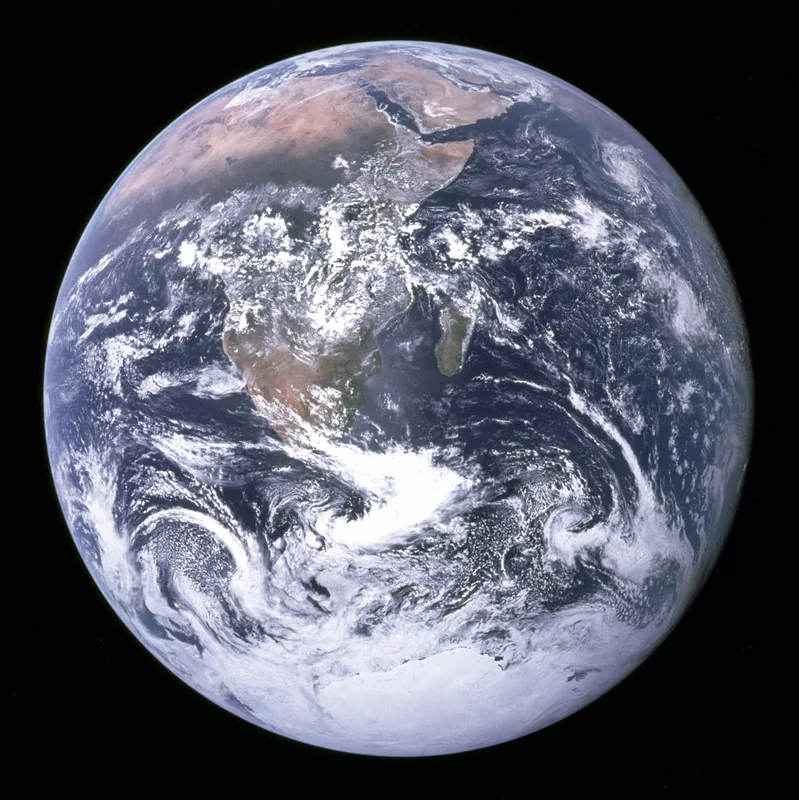
Enjoyed two official distances for an AU, a 71-percent ocean, and a pale blue dot in a sunbeam?
No pop-ups. No intrusive advertising. Just interesting stuff. A little support helps the next planets.im site get built.