The ocean planet
The only planet with liquid water on the surface
NASA Science says it directly: most of the planet is covered in liquid water, the oceans hold 97% of it, and almost all of Earth’s volcanoes, and its longest mountain range, are hidden underneath.
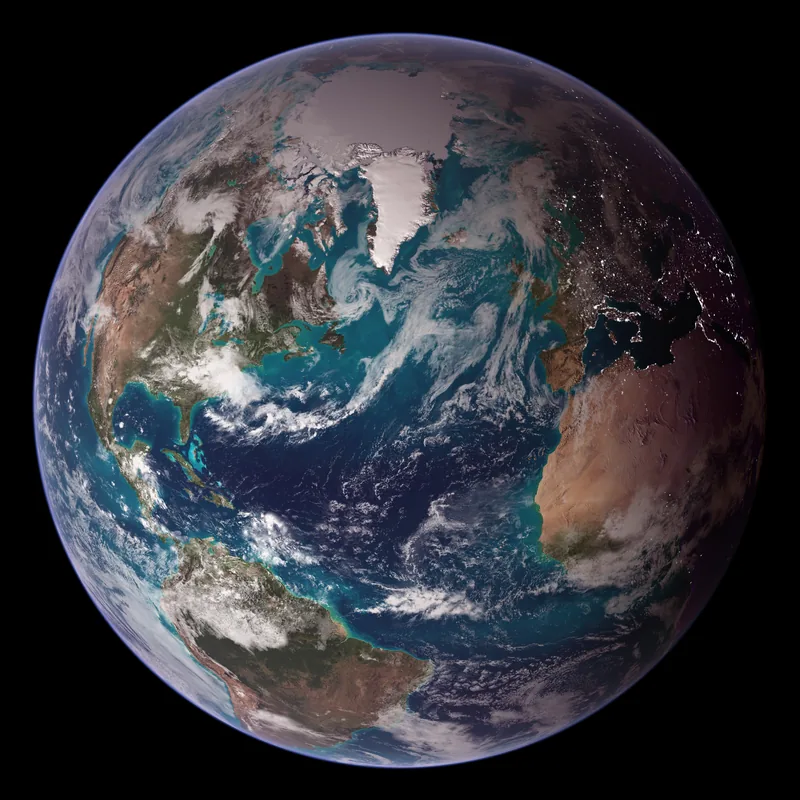
NASA Science is plain: Earth is the only planet in our solar system with liquid water on the surface. The global ocean covers about 71% of the planet’s surface, has an average depth of about 2.3 miles (3.6 kilometres), and contains 97% of Earth’s water. [source] The fact sheet does not put a 71% figure in its bulk table. It does give a total mass of the hydrosphere of 1.4 × 10²¹ kg, against 5.1 × 10¹⁸ kg for the atmosphere, and an average temperature of 288 K (15°C). [source]
The same Science page adds a few facts that stay surprising even if you have lived here all your life. Almost all of Earth’s volcanoes are hidden under those oceans. Hawaii’s Mauna Kea volcano is taller from base to summit than Mount Everest, but most of it is underwater. Earth’s longest mountain range is also underwater, at the bottom of the Arctic and Atlantic oceans, and is four times longer than the Andes, Rockies and Himalayas combined. [source]
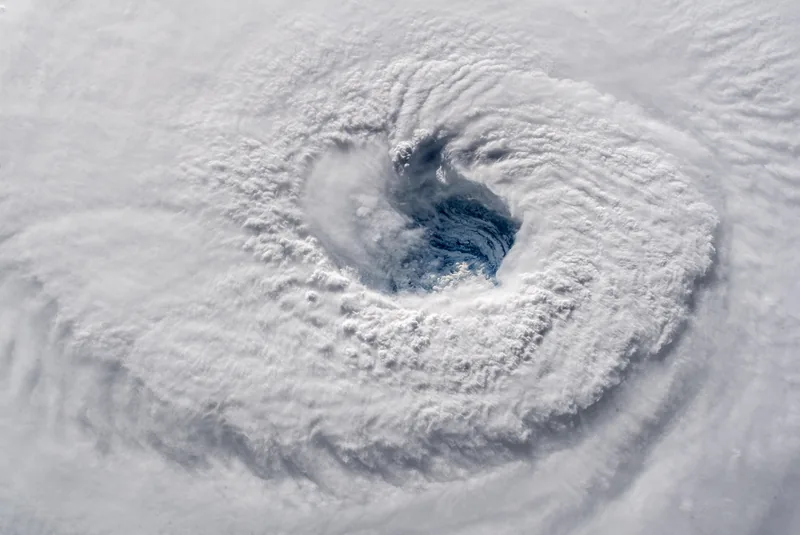
A photograph from the International Space Station on 12 September 2018 looks down the eye of Hurricane Florence. Weather is not a separate subject from the ocean and the air. The fact sheet gives wind speeds of 0 to 100 m/s and a dry-air composition of 78.08% nitrogen and 20.95% oxygen, with argon 9,340 ppm and carbon dioxide 420 ppm, and notes that water is highly variable, typically about 1%. [source] NASA Science’s public wording is 78% nitrogen, 21% oxygen, and 1% other gases such as argon, carbon dioxide and neon. [source] The two official accounts are left distinct; the 1% on the Science page is “other gases,” while the fact sheet’s typical 1% is water, which it treats separately.
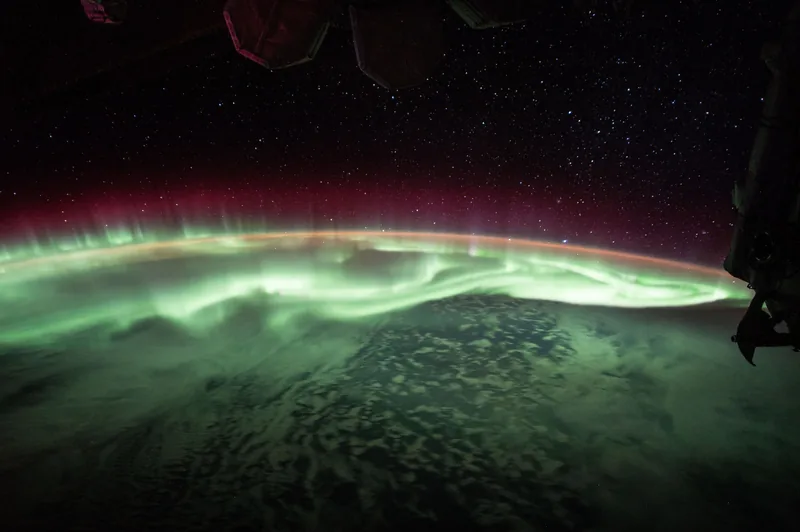
NASA Science ties the aurora to the magnetosphere: charged particles from the solar wind, trapped in Earth’s magnetic field, collide with air molecules above the magnetic poles, and the air molecules glow. [source] The still above is that glow over Antarctica, photographed by NASA astronaut Jack Fischer on 25 June 2017. The fact sheet’s magnetosphere notes include a dipole field strength of 0.306 Gauss-Re3 and a 2020 World Magnetic Model magnetic north pole at 86.50 N, 164.04 E. [source]
The official distances that place this wet world one AU from its star are on the AU desk.
Enjoyed two official distances for an AU, a 71-percent ocean, and a pale blue dot in a sunbeam?
No pop-ups. No intrusive advertising. Just interesting stuff. A little support helps the next planets.im site get built.