Myths versus facts
What the official pages actually say
An AU is not one silently agreed number. A composite is not a single shutter click. Earth’s English name is the ground, not a god.
Myth: everyone agrees how far the Sun is
Two official NASA pages, opened on the same day, do not give the same kilometre figure. The fact sheet’s semimajor axis is 149.598 million kilometres. [source] NASA Science’s facts page gives 150,196,428 kilometres, or 93,327,712 miles. [source] This desk keeps both, and does not average them.
Myth: a day is 24 hours, and that is the whole story
The fact sheet lists a length of day of 24.0000 hours and a sidereal rotation period of 23.9345 hours. [source] NASA Science says one rotation every 23.9 hours. [source] Those are official clocks of slightly different kinds, not a disagreement about whether Tuesday follows Monday.
Myth: the Blue Marble and the modern ‘Blue Marble’ composites are the same kind of picture
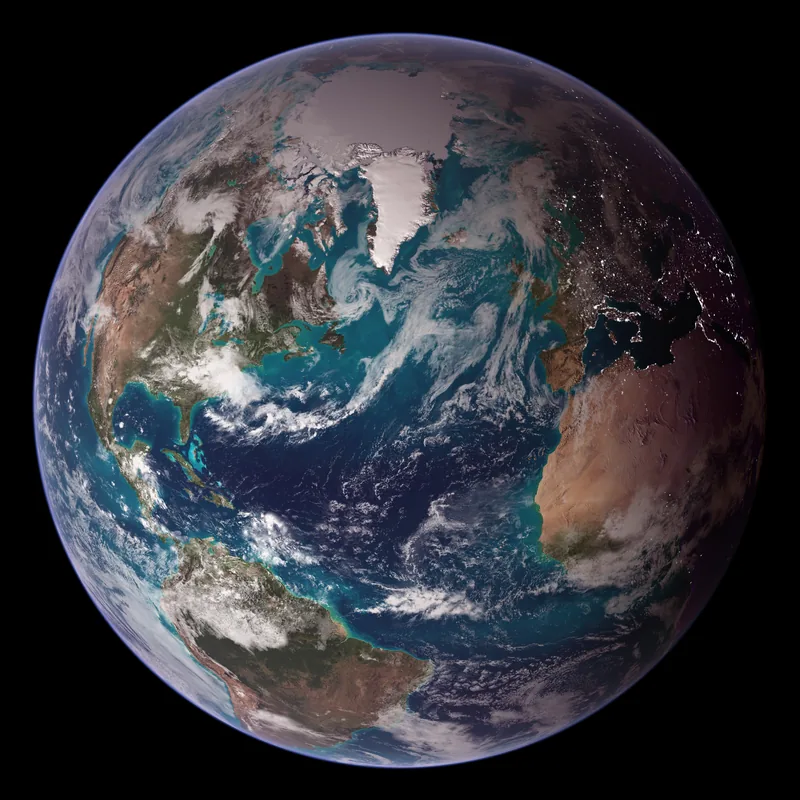
The 7 December 1972 still is a photograph from Apollo 17, with a small honest doubt about which crewmember pressed the shutter. The 2007 western-hemisphere image, and the 2016 Black Marble night map, are composites, assembled from satellite data, and their official captions say so.
Myth: the Pale Blue Dot is a globe you can read
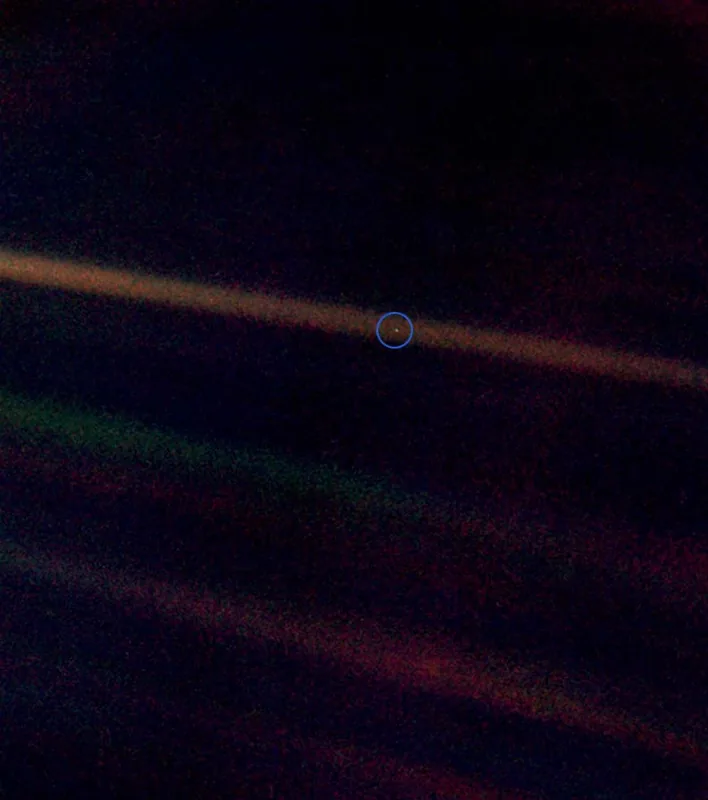
The official caption asks you to find a speck in a sunbeam. If you can see continents in a reproduction, someone has exaggerated the wrong part of the picture.
Myth: Earth is just the third rock, with a name like the others
NASA Science says Earth is the only planet in the solar system whose English name does not come from Greek or Roman mythology. The name is about 1,000 years old, a Germanic word that simply means “the ground.” [source]
Enjoyed two official distances for an AU, a 71-percent ocean, and a pale blue dot in a sunbeam?
No pop-ups. No intrusive advertising. Just interesting stuff. A little support helps the next planets.im site get built.