Field notes
Useless’s field notes
Official wording, kept distinct. A few pictures that would mislead without their captions.
Useless has been comparing official pages, and reading file captions twice.
149.598 million kilometres, and 150,196,428 kilometres
The fact sheet’s semimajor axis and NASA Science’s facts-page distance are both official, and they are not the same number. [source] [source] This site does not invent a compromise AU.
23.9345 hours, 24.0000 hours, and 23.9 hours
Sidereal rotation, length of day, and NASA Science’s rounded public wording. Three official clocks, not a fight.
365.256, 365.242, and 365.25
Sidereal year, tropical year, and Science’s leap-year figure. The leap-day story on the Science page belongs with 365.25.
23.44 degrees and 23.4 degrees
Fact sheet obliquity, and Science’s public wording for the tilt that makes the seasons.
78.08 / 20.95, and 78 / 21 / 1
The fact sheet’s dry-air percentages, with water treated separately as typically about 1%. Science’s 78 / 21 / 1, where the 1% is “other gases.” The two 1% figures are not the same ingredient, and are not merged.
Pictures that need a label
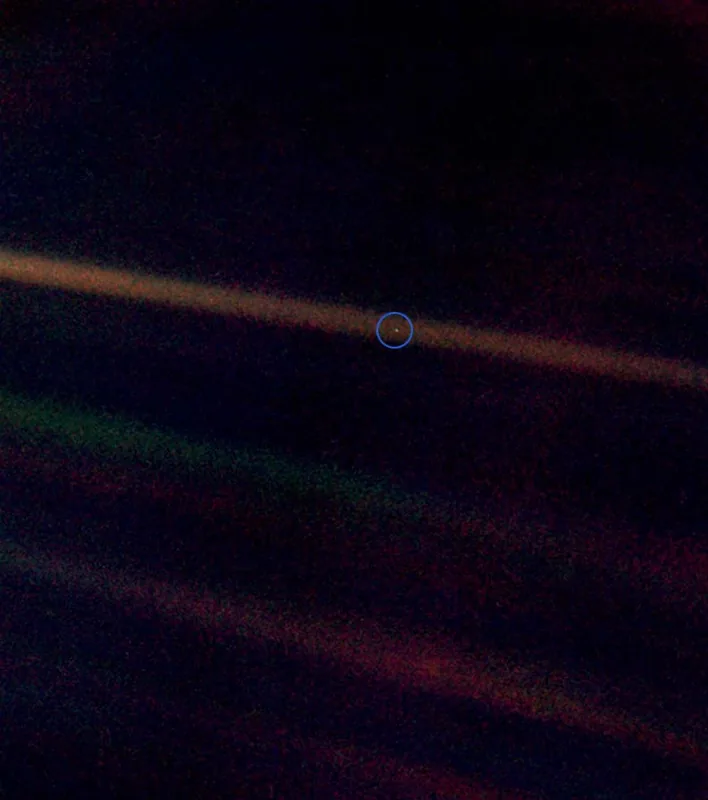
The Blue Marble’s photographer is either Schmitt or Evans. The 2007 western hemisphere and the 2016 Black Marble are composites. The Pale Blue Dot is a speck in a sunbeam. Captions on this site say those things out loud.
Enjoyed two official distances for an AU, a 71-percent ocean, and a pale blue dot in a sunbeam?
No pop-ups. No intrusive advertising. Just interesting stuff. A little support helps the next planets.im site get built.