Questions
Questions people actually ask
Short answers, from official pages and file captions, with the rounding left visible.
Is Earth the only world with life?
NASA Science says it is “the only place we know of inhabited by living things.” [source] That is a claim about what is known, not a proof that nowhere else could ever qualify.
How far is the Earth from the Sun?
The fact sheet’s semimajor axis is 149.598 million kilometres. [source] NASA Science gives 150,196,428 kilometres, or 93,327,712 miles. [source] Both official figures are on the AU desk.
How much of Earth is ocean?
NASA Science: about 71% of the surface, with an average depth of about 2.3 miles (3.6 kilometres), holding 97% of Earth’s water. [source]
Why does Earth have seasons?
NASA Science attributes the yearly cycle of seasons to a 23.4-degree tilt. [source] The fact sheet’s obliquity is 23.44 degrees. [source]
How many moons does Earth have?
One, on both official pages. NASA Science adds that Earth is the only planet in the solar system with only one moon, and that 30 Earth-sized planets could fit between Earth and the Moon. [source]
Who took the Blue Marble photograph?
The file says the Apollo 17 crew, on 7 December 1972, and that it was taken by either Harrison Schmitt or Ron Evans. This site keeps that uncertainty.
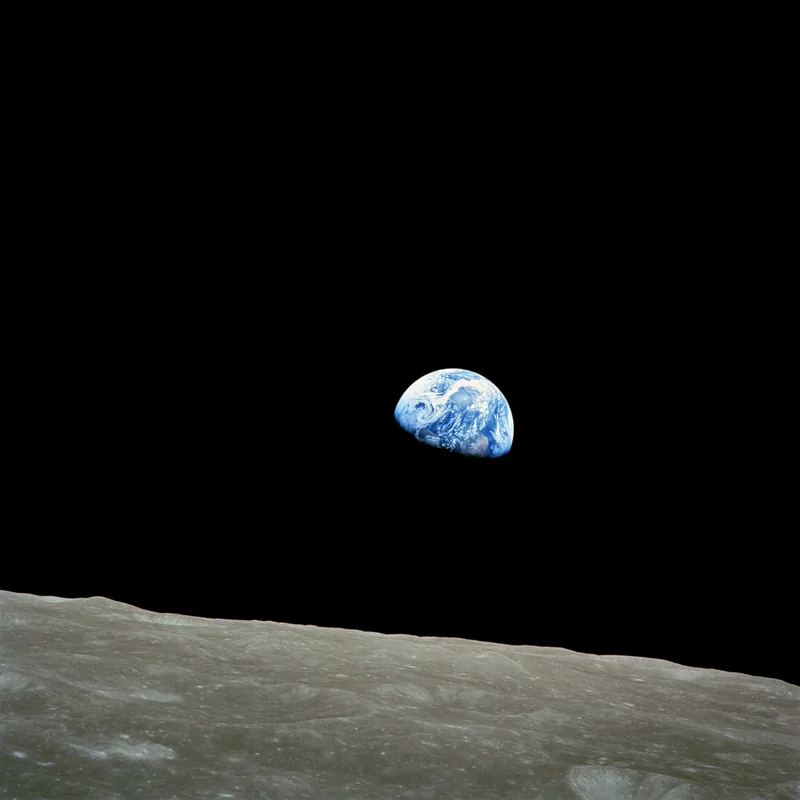
When was Earthrise taken?
By Bill Anders, on Apollo 8, on 24 December 1968, at 16:40 UTC, the third Earthrise of that orbit, according to the official file.
What is the Pale Blue Dot?
A Voyager 1 photograph of Earth, taken on 14 February 1990. The official caption says Earth is a relatively bright speck in the uppermost sunbeam.
Enjoyed two official distances for an AU, a 71-percent ocean, and a pale blue dot in a sunbeam?
No pop-ups. No intrusive advertising. Just interesting stuff. A little support helps the next planets.im site get built.